Biostimulants, soil improvers and wetting agents in forest trees
In 2025, Viaverda screened biostimulants, soil improvers and wetting agents for their ability to increase the drought stress tolerance of ornamental forest trees (Acer pseudoplatanus) under rain-fed conditions.
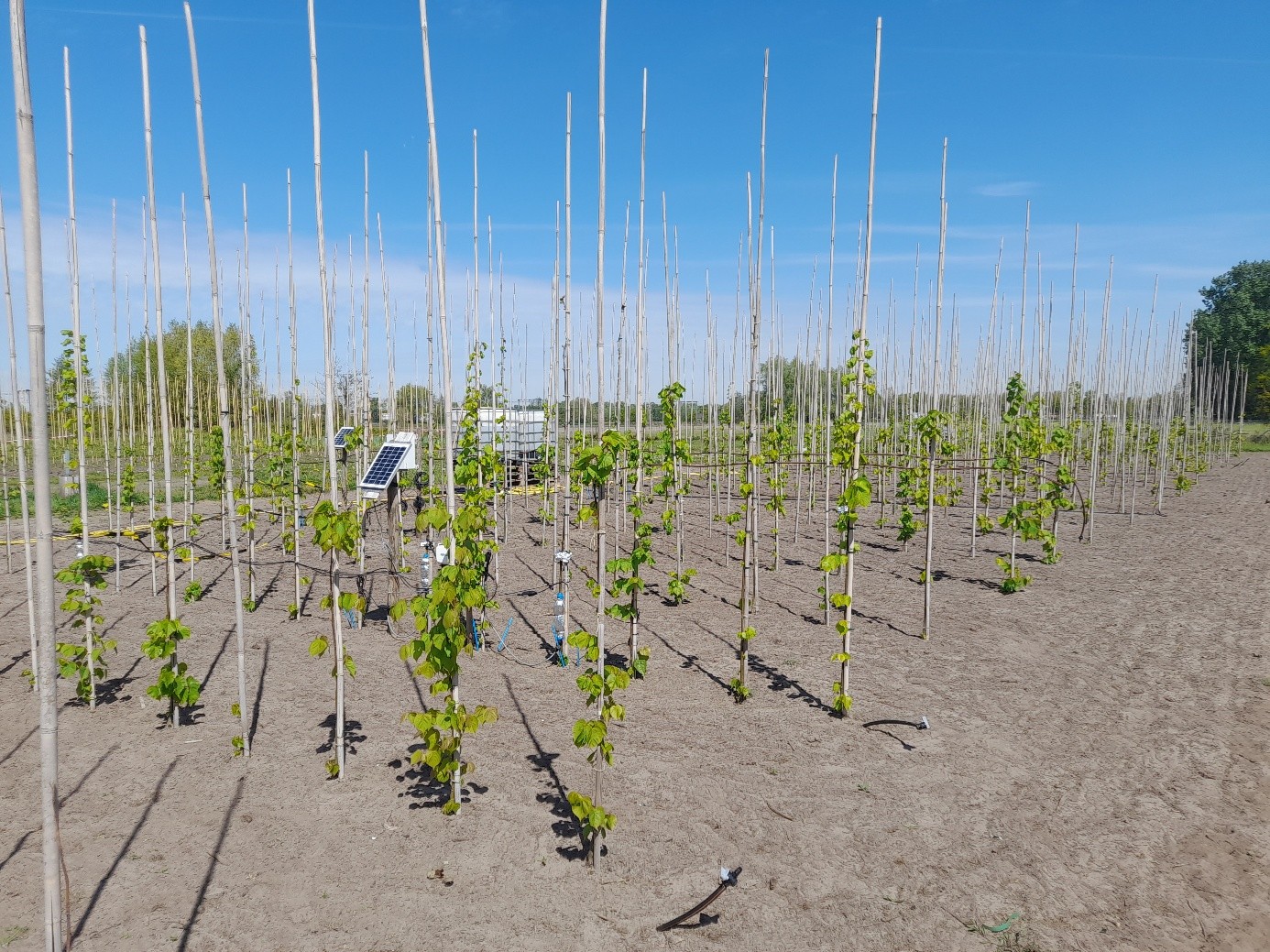
The growth season of 2025 was characterised by a very dry spring followed by a dry summer. Application of the products didn’t result in substantial improvements in plant height or biomass compared to the untreated control. Some products combined a lower % tree mortality and an increased early growth, indicating these products can help to give the trees a beneficial start in dry conditions.
Follow-up trials will have to show whether this observation is also seen in the following years. The most promising products will be evaluated on a lager scale in the growth season of 2026.
Tillage techniques and weed control measurements in avenue trees
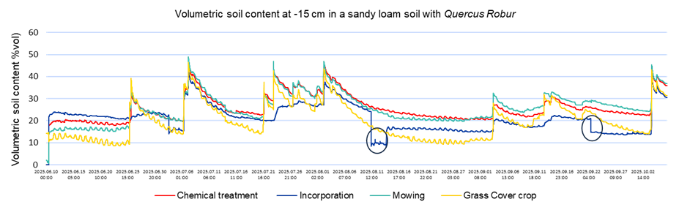
Different weed control measurements (chemical, mechanical, cover crop of Lollium perenne and frequent mowing of the winter cover crop) were evaluated for their effects on soil moisture, organic matter, and tree performance.
After one growth season, no significant impact on tree performance is seen. A grass cover crop results in a consequently lower soil moisture value, indicating competition for water. Mechanical weeding lowered soil moisture in the top 0–15 cm soil layer, likely due to increased evaporation after cultivation. This trial will be continued in the growth season of 2026, to see if the chemical weed treatment has a negative impact on tree growth in the following season, it will also be interesting to follow up what the eventual impact of the competition for soil moisture and nutrients between the grass cover crop and the trees, on the economic value of the end product.
Comparison of irrigation techniques in avenue trees
Over the next four growing seasons, the effects of five irrigation techniques on the growth and soil moisture status of avenue trees, Tilia cordata, will be evaluated:
- no irrigation (rainfed),
- irrigation with dripline on ground (daily gift),
- irrigation with dripline installed in ground (-20cm) (daily gift),
- irrigation with dripline installed on 1m height (daily gift),
- irrigation with T-tape connected with
cubic tanks (weekly gift, higher dose).
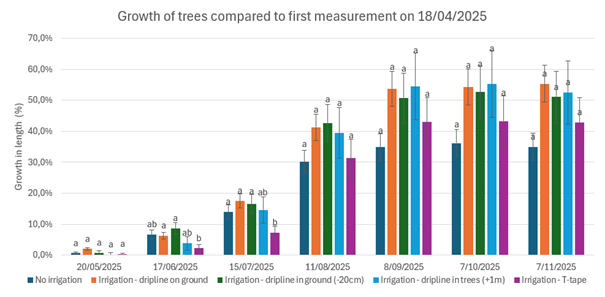
Irrigation—whether a small daily gift
or a larger weekly gift —resulted in stronger tree growth compared to a first
measurement taken at the start of the season. Results from the first growing
season showed that subsurface drip irrigation at 20 cm depth caused part of the
water to leach into deeper soil layers, reducing water availability for the
trees. Despite the leaching of the irrigation water, no negative effect on tree
growth was observed compared to irrigation with the dripline installed at the
soil surface. Weekly T-tape irrigation produced strong fluctuations in soil
moisture, with sharp peaks after the irrigation gift followed by rapid
declines, and resulted in slower tree growth compared with the tree growth
observed under small daily irrigation doses.