In September 2026, the Section of Organic Farming and Cropping Systems of the University of Kassel, Germany, organised a field day on climate adaptation in organic vegetable production at its research farm Domäne Frankenhausen, Germany. The event brought together farmers, agricultural advisors and researchers to discuss approaches to improve soil health, water management and the resilience of vegetable production systems under changing climatic conditions. A total of 86 participants participated to the event, approximately one quarter from farming, one quarter from agricultural advisory services and half from research.
Throughout the day, participants visited experimental fields and demonstration stations presenting ongoing research on soil management, cover crops, water availability and crop resilience. The programme included contributions from several research projects, such as HydroSoilWise, Ground2Live, ADAPT, ROBUSTGemüse and Bio-Klima-Gemüse to present the diversity of vegetable research ongoing.
HydroSoilWise field trials
At the HydroSoilWise field station, Dr. Christiane Weiler (University of Kassel) presented ongoing experiments investigating the effects of cover crops and subsoil loosening on soil structure and water availability for subsequent onion cultivation.
The trials aim to assess whether cover crops such as phacelia can improve soil structure through intensive rooting and thereby facilitate water uptake by subsequent crops. Subsoil loosening is investigated as an additional measure to reduce soil compaction and improve rooting conditions.
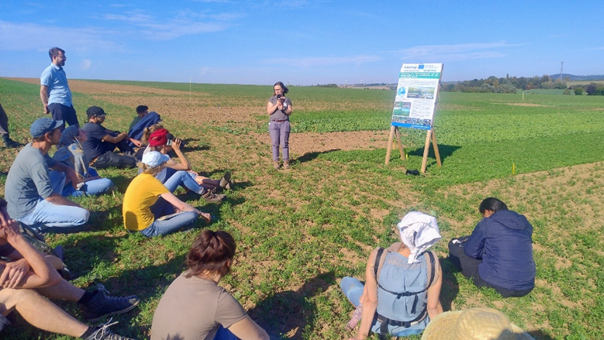
Initial measurements of soil penetration resistance showed treatment effects particularly at depths of 10–30 cm. Subsoil loosening reduced penetration resistance, while the effects of cover crops varied depending on site and measurement date. So far, no consistent effects on soil moisture have been observed. Ongoing analyses of onion root samples will help determine whether the treatments promote deeper rooting and improve access to soil water.
Exchange between research and practice
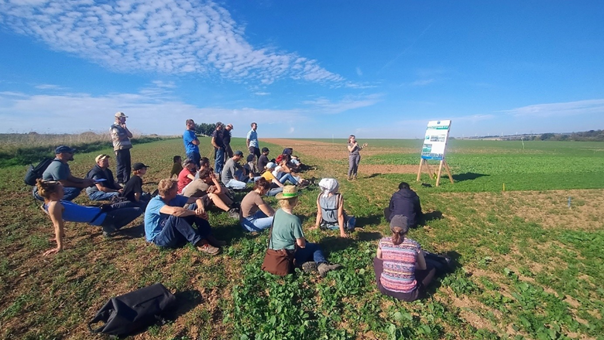
The field visits provided opportunities for participants to discuss the experimental approaches, ask questions and exchange experiences from agricultural practice. In addition to the HydroSoilWise trials, other stations presented research on undersown cover crops, mulching systems, soil fertility, plant health and climate-resilient vegetable varieties.
The discussions highlighted the importance of considering different soil and crop management practices together when developing strategies for climate adaptation. They also provided an opportunity to reflect on the practical applicability of the approaches presented and the challenges associated with their implementation.
Overall, the field day demonstrated the value of direct exchange between farmers, advisors and researchers. For HydroSoilWise, it offered an opportunity to present current experimental work, discuss preliminary findings and gather perspectives from agricultural practice to support the further development of soil and water management strategies.